

Accountability by Design: Turning AI Standards into Practice and Certification
Exploring how the EU AI Act translates harmonized standards into real-world AI testing and certification. Discover how the EU AI Act moves from regulatory text to technical implementation — and what this means for organisations developing and deploying AI systems.

This joint session brings together two complementary perspectives on AI accountability: applied AI assessment and certification from Fraunhofer IAIS, and European standardisation from CEN-CENELEC JTC 21. Dr. Maximilian Poretschkin and Dr. Sebastian Hallensleben will explore how the regulatory framework of the EU AI Act translates into technical practice — from testing and certification of AI systems to the development of harmonized standards that guide implementation across Europe.
The webinar highlights the interaction between those who develop the rules and those who must apply them in practice, with particular attention to the implications for SMEs and research institutions working with limited resources.
Date and Time Wednesday, March 18th, 2026 | 16:30 – 17:30 CET Online | Free Registration REGISTRATION: https://forms.office.com/e/j0CUx4dTsM
This webinar is organized by the Slovak National Supercomputing Centre (NCC Slovakia) as part of the EuroCC project (National Competence Centre – NCC Slovakia).
This webinar is organized by the Slovak National Supercomputing Centre (NCC Slovakia) as part of the EuroCC project (National Competence Centre – NCC Slovakia). This session continues the AI Accountability Dialogue Series – “Who Is Responsible for AI in Europe?”, a series exploring how responsibility for artificial intelligence is defined and implemented across ethical, legal, and technical domains.
The webinar will be held in English.
The EU AI Act establishes a comprehensive regulatory framework for artificial intelligence in Europe, but how do its requirements translate into technical reality?
This joint session presents two complementary perspectives on AI accountability. Dr. Maximilian Poretschkin (Fraunhofer IAIS) draws on his experience leading the ZERTIFIZIERTE KI project to discuss the current state of AI assessments — how organizations and AI systems can be evaluated against legal and technical requirements, and what practical certification processes look like today.
Dr. Sebastian Hallensleben (CEN-CENELEC JTC 21) provides the perspective of European standardization, explaining how harmonized standards supporting the AI Act are being developed and how they guide the technical implementation of regulatory requirements.
Together, the speakers explore the interaction between rule-making and practical implementation — and what this means for organisations navigating AI compliance, technical verification, and trust in AI systems.
Dr. Maximilian Poretschkin is Head of Department AI Assurance and Assessment (AAA) at Fraunhofer IAIS in Sankt Augustin, Germany. His work focuses on the testing, evaluation, and certification of trustworthy AI systems. He leads the “ZERTIFIZIERTE KI” project, which develops testing methodologies, assessment tools, and certification approaches for artificial intelligence and transfers the results obtained in AI standardization. With a background in physics and experience in both research and industry consulting, his current work focuses on practical methods for evaluating AI systems, forensic analysis of AI behaviour, and compliance strategies for advanced AI systems such as large language models.
Dr. Sebastian Hallensleben is Chair of the CEN-CENELEC JTC 21 technical committee on Artificial Intelligence and Chief Trust Officer at Resaro Europe. His work focuses on digital trust, AI governance, and the development of harmonized standards supporting the implementation of the EU AI Act across Europe. In addition to his European standardization work, he contributes to international initiatives on AI risk and accountability, including co-chairing the OECD working group on AI risk and accountability. His work focuses on translating ethical and regulatory principles into measurable technical standards for trustworthy AI systems.
Format
- Opening presentation by Dr. Maximilian Poretschkin (15–20 minutes) AI assessment, testing, and certification in practice
- Opening presentation by Dr. Sebastian Hallensleben (15–20 minutes) European standardization framework underpinning the AI Act
- Moderated discussion and audience Q&A (approximately 20–30 minutes)
 Keď hmla nečakane udrie 22 Aug - Ako včas odhaliť hmlu ako „neviditeľnú“ hrozbu skôr, než ochromí naše cesty?
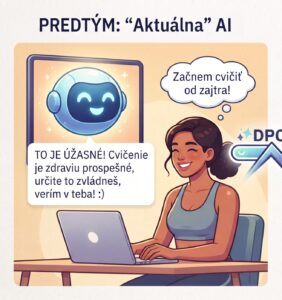 Stop digitálnym pochlebovačom 16 Aug - Vedkyňa pomocou superpočítača prelomila zvyk modelov AI len prázdne chváliť a naučila ich dávať úprimnú, kritickú spätnú väzbu
 Odvrátená strana bezplatných hier 11 Jul - Ako slovenský tím s pomocou superpočítača vyriešil rébus extrémne vzácneho správania hráčov