
The Slovak Recipe for Fair Play and Happier Players
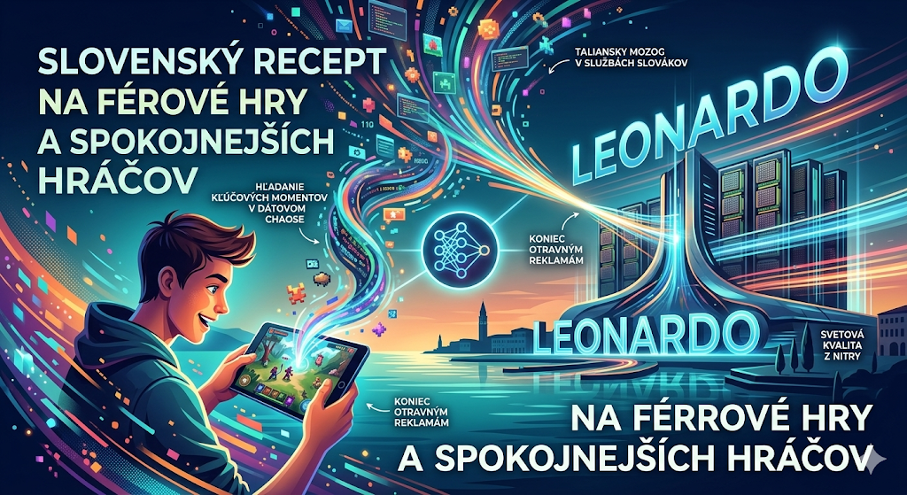
Do you play games on your phone and sometimes feel like the game just doesn’t understand you? Experts from Nitra, Slovakia, have used one of Europe’s most powerful supercomputers to change that. Thanks to the Italian giant named Leonardo, they discovered how to read between the lines of player behavior and make the gaming experience more personal and fair.
Challenge
When millions of people play mobile games, a data chaos emerges. Most players simply “wander” through the game world, while only a small percentage do something important—such as purchasing an upgrade or angrily quitting the game. For ordinary computers, finding these key moments in a sea of routine activity is an almost unsolvable problem, because important events make up only a tiny fraction of the massive dataset. It is like trying to find one specific face in a blurred crowd at a stadium without a proper pair of binoculars.
Solution
The team from Nitra enlisted the help of the supercomputer Leonardo. It is equipped with thousands of graphics cards capable of “thinking” many times faster than a regular laptop. The researchers worked with a large organic dataset of about 9 GB and used advanced technologies that function as simulators of behavior.
Thanks to this computing power, gaming experts were able to incorporate feedback from specialists almost immediately. Instead of researchers spending weeks struggling with analysis and searching for the right groups of players, the supercomputer delivered precise answers within just a few days.
Impact
The use of supercomputing infrastructure has produced results that will benefit not only players, but the entire digital industry:
- An End to Guesswork: Researchers developed a precise methodological approach to dealing with extremely imbalanced data, which can also be applied to detecting fraud in banking or in medicine.
- Games That Understand You: A prototype model was developed that can predict a player’s needs already in the early stages of the game, allowing the experience to be tailored to each individual.
- Game-Changing Speed: What would previously have taken weeks was completed by the Slovak team in just a few days thanks to HPC.
- A Universal Guide: Although the research was conducted on a specific game, the developed approach is a “hack” that any programmer in the world can use for any gaming platform.
Looking Ahead
The team from the Constantine the Philosopher University in Nitra, specifically the Faculty of Natural Sciences, now plans to validate the acquired insights in real-world operations. In doing so, Slovak researchers have demonstrated that research from Slovakia can achieve global relevance—provided it has access to the right tools to overcome digital barriers.
 Keď hmla nečakane udrie 22 Aug - Ako včas odhaliť hmlu ako „neviditeľnú“ hrozbu skôr, než ochromí naše cesty?
 Stop digitálnym pochlebovačom 16 Aug - Vedkyňa pomocou superpočítača prelomila zvyk modelov AI len prázdne chváliť a naučila ich dávať úprimnú, kritickú spätnú väzbu
 Odvrátená strana bezplatných hier 11 Jul - Ako slovenský tím s pomocou superpočítača vyriešil rébus extrémne vzácneho správania hráčov