
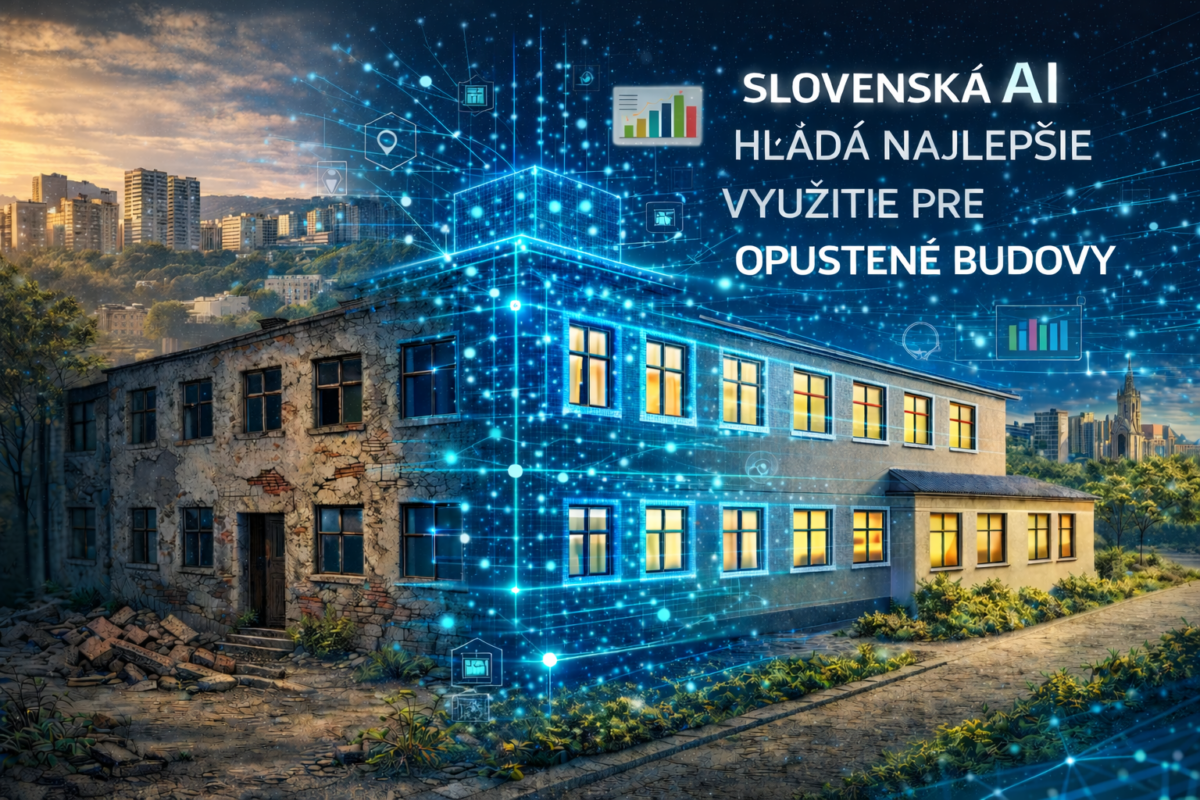
Urban buildings awaken: Slovak AI gives a second chance to underused spaces
Cities are living organisms that constantly evolve. Yet many of us pass daily by silent witnesses of the past in our neighborhoods—empty schools, unused administrative buildings, or deteriorating public facilities. We often ask ourselves: “Why is this closed?” “Couldn’t this space serve as a day-care center, a kindergarten, or a cultural hub instead?”
Finding the right function for such a building, however, is not just a matter of having a good idea. It is a complex urban planning puzzle. This is precisely the challenge that a Slovak team from the organization Creative Industry Košice (CIKE) has set out to address. As part of the SAM-SUD (Smart Asset Management – Sustainable Urban Development) project, funded by the European Union, they are developing a tool called NextUseAI. Their goal is to create an intelligent system that can help cities determine which functions best fit a given location, taking into account the overall urban structure, the priorities defined in municipal strategies, and—most importantly—the real needs of residents in that specific area.
Challenge: Millions of Microlocations in the Digital World
Planning a city according to people’s needs means understanding space. The concept of the “15-minute city” suggests that everything essential should be accessible within walking distance. However, for artificial intelligence (AI) to provide meaningful guidance to cities, it must first process vast amounts of data about every street, sidewalk, and existing service.
The Slovak team worked with data on the scale of hundreds of gigabytes, including map data from OpenStreetMap, digital elevation maps, and databases containing thousands of public amenities. The challenge was to transform these datasets into complex mathematical matrices of walking distances.
In the initial phase of the project, we needed to identify weaknesses in our process through rapid iterations and quickly reach results, understand them, and then adjust the input parameters again. Even at this stage, we had to process substantial volumes of data in which the neural network could detect significant patterns. On a regular computer, this would have taken weeks. Without extreme computing power, it would not have been possible to achieve the first meaningful results in such a short time,” says Róbert Pollák, head of the NextUseAI research team.
Solution: The Power of the MeluXina Supercomputer
The breakthrough came thanks to access to the European supercomputer MeluXina in Luxembourg, specifically to the part dedicated to artificial intelligence (the AI Factory). Here, Slovak experts were given access to powerful graphics accelerators capable of processing thousands of operations simultaneously.
In this environment, the team built and tested advanced neural networks. These networks were trained to recognize relationships between buildings, services, and their surroundings across different cities. Supercomputing enabled us to experiment with different configurations and quickly fix errors, which would not have been possible under normal conditions. Thanks to this, we were able to rapidly generate a method for producing spatial recommendations for the two largest Slovak cities—Bratislava and Košice. The models can learn from the spatial structure of one or multiple cities and provide recommendations for another city,” adds Timotej Kendereš, a data analyst at CIKE responsible for working with the MeluXina supercomputer.
Results: Data in the Service of People
The result is not just a dry table of numbers. The AI model aims to propose concrete functions for underused urban spaces to city planners and strategists in order to improve public amenities and walkable accessibility within neighborhoods. NextUseAI will then evaluate spatial recommendations in the context of residents’ needs and the city’s strategic priorities, accompanied by a clear explanatory rationale.
Although the results are currently still in the experimental phase and serve to calibrate the entire system, they have already demonstrated an important insight: artificial intelligence can detect patterns and connections that may escape human observation. For example, the system can identify “blind spots” in a city—areas where a particular service is missing—and suggest placing it in a nearby underused building.
Impact and Future Potential
NextUseAI does not end in the laboratory. Its ambition is to become a practical tool that helps city leaders make decisions based on data rather than intuition.
For residents, this could mean in the future:
- More efficient local governance: Public funds will be invested in buildings with a clear purpose and tangible benefits.
- Less time spent in cars: Services will be located where people actually live.
- A more attractive environment: Abandoned buildings will get a new chance instead of falling into decay.
The use of European supercomputers is thus bringing a technological leap to Slovak urban planning. It shows that AI does not have to remain an abstract concept, but can become a useful ally that helps us build cities where people can live better and healthier lives.
 Apply for the EUMaster4HPC Summer School 2026 focused on High-Performance Computing. 23 Mar - From 5 to 14 July 2026, the EUMaster4HPC Summer School titled “High-Performance Computing and Emerging Trends” will take place in Luxembourg. The event will be held at the Marienthal Youth Center and the University of Luxembourg in Belval.
 Lecture on HPC, AI and Career Opportunities 15 Mar - At the Faculty of Commerce of the University of Economics in Bratislava (EUBA), a guest lecture was held on 10 March 2026 focusing on current trends in high-performance computing (HPC), artificial intelligence (AI), and career opportunities in the digital environment.
 AI and Supercomputers in Practice: A Lecture for TUKE Students 13 Mar - On 5 March 2026, an expert lecture by Dr. Lucia Malíčková from the National Supercomputing Centre (NSCC) took place at the Technical University of Košice (TUKE), titled “Can Supercomputers and Artificial Intelligence Be Useful?”. The event was held in lecture hall PK7 in a hybrid format (both online and in person) and was attended by 110 TUKE students.