
Success story: AI Helps Save Women’s Lives
Fear of breast cancer is a silent companion for many women. All it takes is an invitation to a preventive screening, a single phone call from a doctor, or the wait for test results—and the mind fills with questions: “Am I okay?” “What if I’m not?” “Could something be missed?”
Even when screening confirms a negative result, the worries often persist.
That is precisely why it makes sense to seek new ways to detect cancer as early as possible—not to replace doctors, but to help them see more, faster, and with greater confidence. And this is where artificial intelligence enters the story. Not as a sci-fi technology, but as a tool that may one day help protect lives.
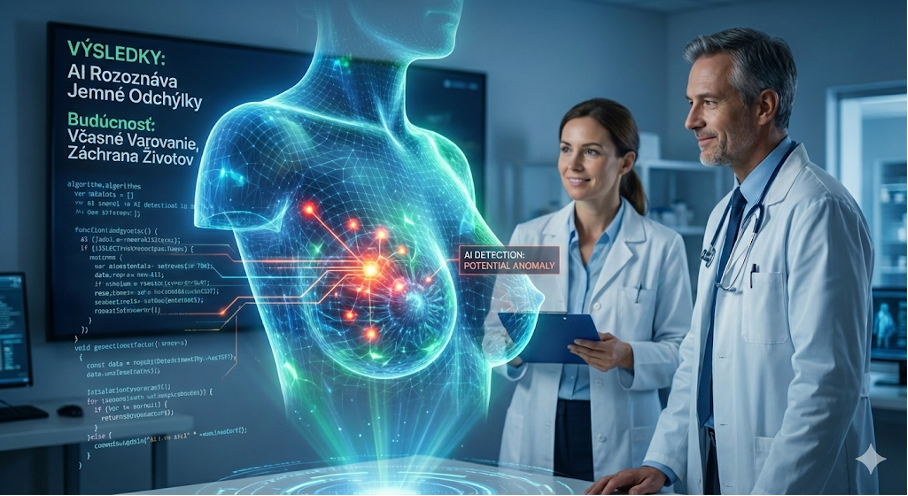
A Slovak research team from the University of Žilina has brought together medicine, artificial intelligence, and European supercomputers in a joint project with a clear goal: to improve the accuracy of breast cancer detection and support doctors in the interpretation of mammographic images.
Challenge
Mammography generates enormous volumes of imaging data. A single project may work with hundreds of thousands of images at extremely high resolution. The Slovak team from the University of Žilina worked with more than 434,000 mammograms, representing data on the scale of several terabytes.
At the same time, the team decided to use a foundation model—a massive neural network with nearly a billion parameters, originally developed for general image analysis. Such a model has enormous potential, but it also places extreme demands on computing power, memory, and data processing speed.
It quickly became clear that standard research infrastructure was simply not sufficient for such a volume of computations. Without a supercomputer, the project could not have continued.
Solution
The breakthrough came when the project gained access to the AI Factory VEGA in Slovenia, which is part of the European EuroHPC initiative. For the first time, Slovak medical AI research was able to work on infrastructure with a level of performance it had never had access to before.
On this platform, state-of-the-art NVIDIA H100 graphics accelerators, designed specifically for artificial intelligence, were available. The researchers built a complete technological pipeline there, from processing mammographic images to training the model itself.
First, the data had to be cleaned, optimized, and prepared so it could be loaded efficiently during computation. Then the process of adapting the large AI model began, as it “learned” to understand the subtle details of mammography. This was not a one-off computation—it was an incremental process in which the model improved step by step.
The supercomputer thus became not only a powerful tool but a key partner in research. It made it possible to do what was previously virtually impossible: to train a massive medical AI model at once using an enormous volume of data.
Results
Researchers have shown that artificial intelligence can learn from mammographic images in a way that gradually enables it to distinguish between healthy tissue and changes that may signal a problem. In other words, the system began to learn how to “look” at images in a manner similar to a physician—searching for subtle details and small deviations that can be very difficult for the human eye to notice.
This progress is particularly important because it represents the first step toward enabling artificial intelligence to flag changes that a human might not notice at first glance. It is not about replacing the physician, but about providing a supporting tool that can help clinicians make decisions with greater confidence, especially in borderline and ambiguous cases.
Impact and future potential
If this research continues to be further developed, artificial intelligence could become a silent assistant in preventive screening. It can speed up the evaluation of imaging data, reduce the risk of overlooking subtle changes, and help detect disease at a stage when it is still highly treatable.
Pre ženy to v praxi znamená väčšiu šancu na včasné odhalenie rakoviny a tým aj vyššiu nádej na úplné uzdravenie. Pri negatívnych nálezoch môžu dostať ženy nezávislý a objektívny doplnkový názor a tým si znížia neistotu po skríningu. Hoci je pred vedcami ešte ďalšia práca, už dnes je jasné, že smer, ktorým sa výskum uberá, má veľký zmysel. Cieľ je jednoduchý, ale silný. Využiť moderné technológie tak, aby pomáhali chrániť zdravie a životy žien.
 Artificial Intelligence and a Supercomputer as a New Weapon Against Environmental Disasters 26 Mar - Scientists from Nitra, Slovakia are teaching machines to predict industrial failures before they can cause damage. Thanks to collaboration with the European supercomputer LUMI, they have developed a digital “guardian” capable of detecting pipeline leaks or manufacturing faults with high accuracy—helping protect both the environment and companies’ budgets.
 The Slovak Recipe for Fair Play and Happier Players 25 Mar - Do you play games on your phone and sometimes feel like the game just doesn’t understand you? Experts from Nitra, Slovakia, have used one of Europe’s most powerful supercomputers to change that. Thanks to the Italian giant named Leonardo, they discovered how to read between the lines of player behavior and make the gaming experience more personal and fair.
 Apply for the EUMaster4HPC Summer School 2026 focused on High-Performance Computing. 23 Mar - From 5 to 14 July 2026, the EUMaster4HPC Summer School titled “High-Performance Computing and Emerging Trends” will take place in Luxembourg. The event will be held at the Marienthal Youth Center and the University of Luxembourg in Belval.