
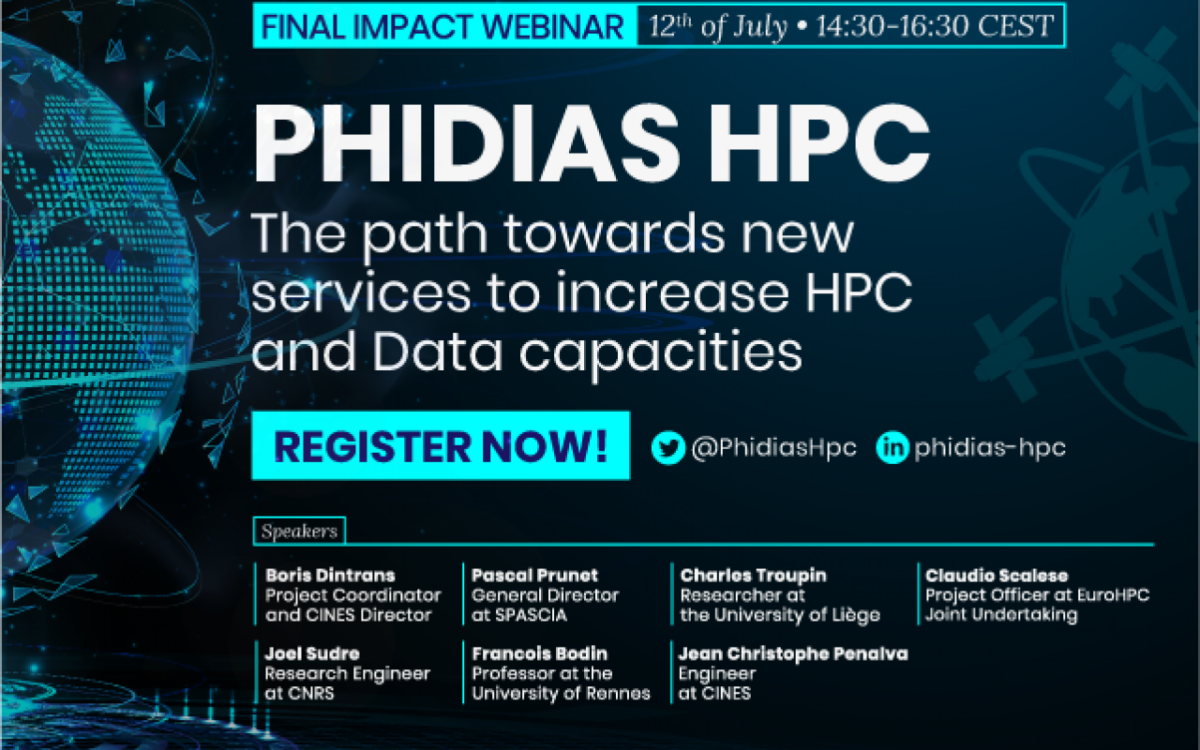
Phidias – Final Impact Webinar
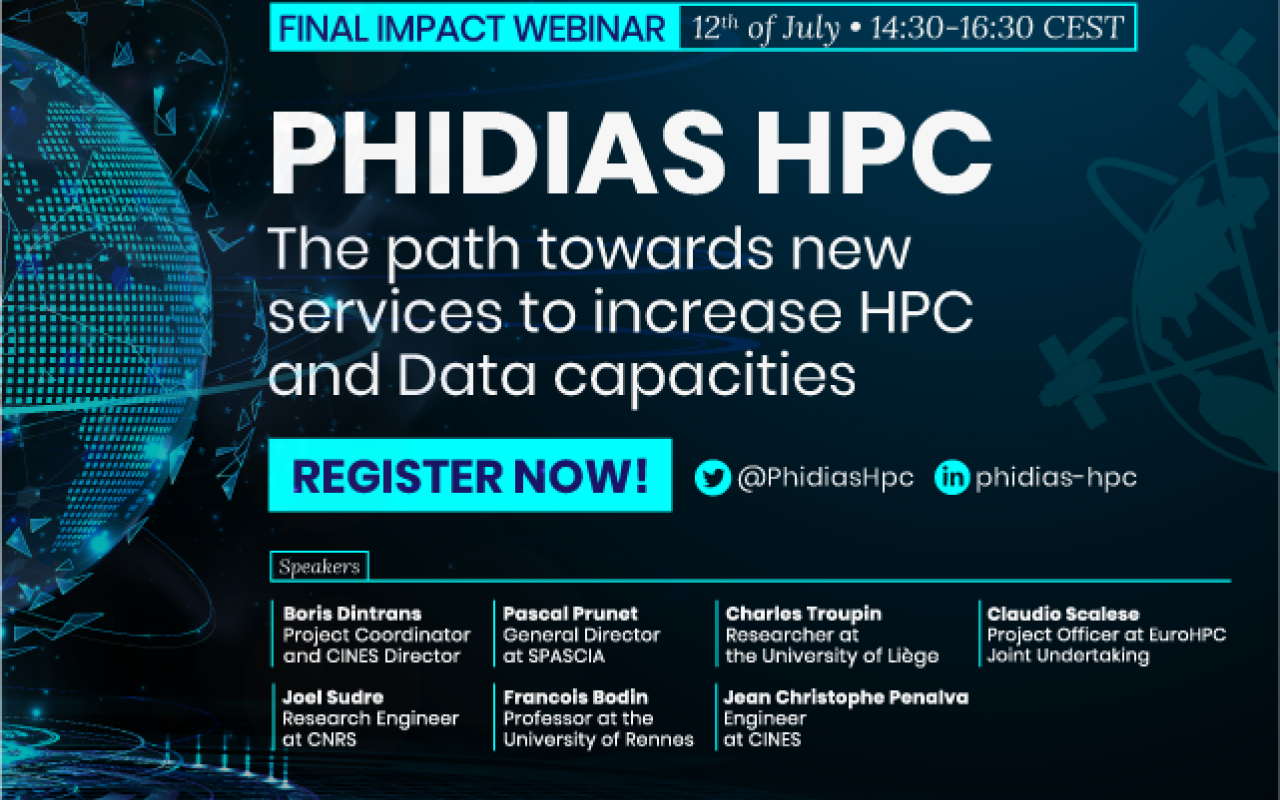
We bring to your attention an online webinar focused on the results achieved by the Phidias HPC initiative in the field of high performance computing. The event, which will take place on July 12 from 2:30 p.m. to 4:30 p.m. is intended for professionals engaged in Earth observation, marine and satellite data, as well as for researchers and developers in the field of HPC.
The project addresses the development and concrete realization of a set of High-Performance Computing (HPC) based interdisciplinary services and tools to exploit large satellite datasets of public European interest provided by:
- Satellite observation of Earth
- FAIR access to processed datasets
- Value-added services through large data storage capability and high-bandwidth network across Europe
This Webinar aims at presenting the tangible outputs achieved by the Phidias HPC initiative at service of the European HPC and Research community, including main features, concrete impact and prospective advantages for Research & HPC ecosphere, mostly in conjunction with the 4 key pillars of the project:
- Building a prototype for earth scientific data.
- Enabling Open Access to HPC Services.
- Strengthening FAIRisation.
- Creating a framework combining computing, dissemination and archiving resources.
The Webinar will feature representatives of the entire Consortium with the specific goal to provide an exhaustive overview of the main advancements of the three Use Cases impacting the Satellite Data, Marine and Ocean data, Earth Observation research communities and to share the most meaningful and innovative lessons learned.
Agenda will be available soon!
 Keď hmla nečakane udrie 22 Aug - Ako včas odhaliť hmlu ako „neviditeľnú“ hrozbu skôr, než ochromí naše cesty?
 Stop digitálnym pochlebovačom 16 Aug - Vedkyňa pomocou superpočítača prelomila zvyk modelov AI len prázdne chváliť a naučila ich dávať úprimnú, kritickú spätnú väzbu
 Odvrátená strana bezplatných hier 11 Jul - Ako slovenský tím s pomocou superpočítača vyriešil rébus extrémne vzácneho správania hráčov