
The National competence centre launches a nation-wide HPC survey
The national competence centre for HPC is launching a nation-wide survey of competencies and requirements in the field of high-performance computing and the usage of HPC+ solutions. Information gained through this survey will help the competence centre to create effective strategies for concrete support and services for private companies, academia and public administration.

The primary goal of the survey is to map the usage of HPC and associated technologies and to identify the demand for these technologies and solutions among Slovak private companies, small and medium enterprises, academic research groups and in public administration. This information is crucial for developing strategies, goals and services for the future National competence centre activities. According to the OECD publication SME Entrepreneurship Policy in Slovak Republic“* the SMEs are facing several barriers in their digital transformation, such as lack of knowledge and experience. The National competence centre enables the knowledge transfer and adoption of HPC, HPDA, AI and ML technologies, where the benefits for private companies include competitive advantage on the market, effective processes, ROI and cost savings.
„“Apart from these activities the National competence centre has an ambition to facilitate the collaboration between experts and end-users coming from various areas and sectors. This survey will help us to identify experts in specific application fields, such as processing big data, advanced simulations and machine learning/artificial intelligence technologies.” the coordinator of the project, Lucia Demovičová, stated.
The survey will also provide information about the computational capacities and resources required at the moment and into the future in Slovakia. Actual local data from Slovak HPC users, including the potential future ones, will be valuable in planning the new high-performance systems and developing the national HPC infrastructure.
The NCC was established within the EuroCC project implemented by the Centre of Operations of the Slovak Academy of Sciences. As a primary contact point for users and all parties interested in HPC in Slovakia the NCC provides several services free of charge that might be interesting for scientific teams, but also the private sector and public administration. Education activities, consultancy and access to computational resources are among the portfolio of NCC services that are meant to support the innovation potential and competitiveness in Slovakia.
Mapping of the HPC environment
* OECD (2021), SME Entrepreneurship Policy in Slovak Republic, OECD Studies on SMEs and Entrepreneurship, OECD Publishing, Paris, https://doi.org/10.1787/9097a251-en.
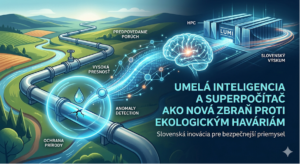 Artificial Intelligence and a Supercomputer as a New Weapon Against Environmental Disasters 26 Mar - Scientists from Nitra, Slovakia are teaching machines to predict industrial failures before they can cause damage. Thanks to collaboration with the European supercomputer LUMI, they have developed a digital “guardian” capable of detecting pipeline leaks or manufacturing faults with high accuracy—helping protect both the environment and companies’ budgets.
 The Slovak Recipe for Fair Play and Happier Players 25 Mar - Do you play games on your phone and sometimes feel like the game just doesn’t understand you? Experts from Nitra, Slovakia, have used one of Europe’s most powerful supercomputers to change that. Thanks to the Italian giant named Leonardo, they discovered how to read between the lines of player behavior and make the gaming experience more personal and fair.
 Apply for the EUMaster4HPC Summer School 2026 focused on High-Performance Computing. 23 Mar - From 5 to 14 July 2026, the EUMaster4HPC Summer School titled “High-Performance Computing and Emerging Trends” will take place in Luxembourg. The event will be held at the Marienthal Youth Center and the University of Luxembourg in Belval.