
Registration Open: Code Tuning for the Exascale.
On June 5-7, 2023, in cooperation with the TREX Center of Excellence and the National Competence Centers for HPC from Austria and the Czech Republic, we are organizing a hands-on workshop focused on the development of HPC applications. Participants will be able to try working with tools for performance analysis and identification of bottlenecks, such as MAQAO. (www.maqao.org). The workshop will include practical exercises, it will be possible to work with your own software, analyze it and consult with expert lecturers.
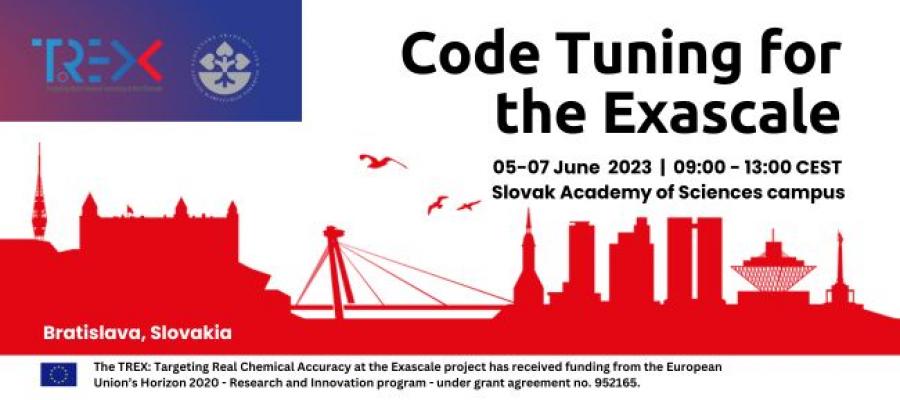
The workshop is targeting specifically code developers and will be focused on code optimisation. Participants are encouraged to bring their own codes to learn about techniques, methods and solutions on how to improve them both in terms of performance and in terms of scalability across multiple platforms.
What are the main goals of this workshop?
- Increasing practical experience in performance, power consumption, and energy efficiency in HPC systems.
- Helping participants to optimise codes to make sure the implementation match their HPC objectives;
- Provide hands-on experience with practical QMC simulations based on CHAMP code.
What can you expect from the workshop?
- During the first day,participants will work together with experts from the Austrian Competence Center for HPC on advanced parallel programming (MPI+X).
- The second day of the program will be devoted to the analysis of the performance of parallel applications, the measurement of energy consumption and the evaluation of energy efficiency on HPC systems under the guidance of experts from the Czech Competence Center for HPC.
- On the last day, participants will explore and analyze the main bottlenecks in node-level application optimization: vectorization, code quality, locality and parallelism. Participants will work under the guidance of experts from TREX CoE.
All topics will be covered in lectures as well as in practical hands-on sessions.The workshop will take place F2F at the SAV campus on Patrónka in Bratislava. Full programme of the workshop will be available in the coming weeks.
The workshop is targeting developers and advanced HPC users with experience in parallel programming and C and/or C++ and/or Fortran programming languages.
Attendees are kindly requested to bring their own laptop.
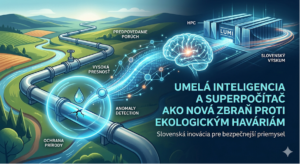 Artificial Intelligence and a Supercomputer as a New Weapon Against Environmental Disasters 26 Mar - Scientists from Nitra, Slovakia are teaching machines to predict industrial failures before they can cause damage. Thanks to collaboration with the European supercomputer LUMI, they have developed a digital “guardian” capable of detecting pipeline leaks or manufacturing faults with high accuracy—helping protect both the environment and companies’ budgets.
 The Slovak Recipe for Fair Play and Happier Players 25 Mar - Do you play games on your phone and sometimes feel like the game just doesn’t understand you? Experts from Nitra, Slovakia, have used one of Europe’s most powerful supercomputers to change that. Thanks to the Italian giant named Leonardo, they discovered how to read between the lines of player behavior and make the gaming experience more personal and fair.
 Apply for the EUMaster4HPC Summer School 2026 focused on High-Performance Computing. 23 Mar - From 5 to 14 July 2026, the EUMaster4HPC Summer School titled “High-Performance Computing and Emerging Trends” will take place in Luxembourg. The event will be held at the Marienthal Youth Center and the University of Luxembourg in Belval.