
Supercomputer Accelerated the Development of Eco-Friendly Hydrogen Production
Hydrogen is one of the key elements driving the transition toward sustainable energy. Its carbon-free production represents a cornerstone of the green energy future — from industry to transportation. However, finding an efficient and affordable way to produce it remains a scientific challenge that brings together chemistry, materials research, and computational modeling.
In this success story, we take a look at how Slovak researchers harnessed the computational power of the NSCC Slovakia supercomputer to accelerate the development of a cheaper and more eco-friendly catalyst for hydrogen production. By combining laboratory experiments with HPC simulations, they succeeded in understanding the behavior of atoms on the surface of a material that could one day replace expensive metals such as platinum.
This research demonstrates how High-Performance Computing (HPC) helps push the boundaries of scientific knowledge and supports the transition toward cleaner and more sustainable energy — right from Slovak laboratories.
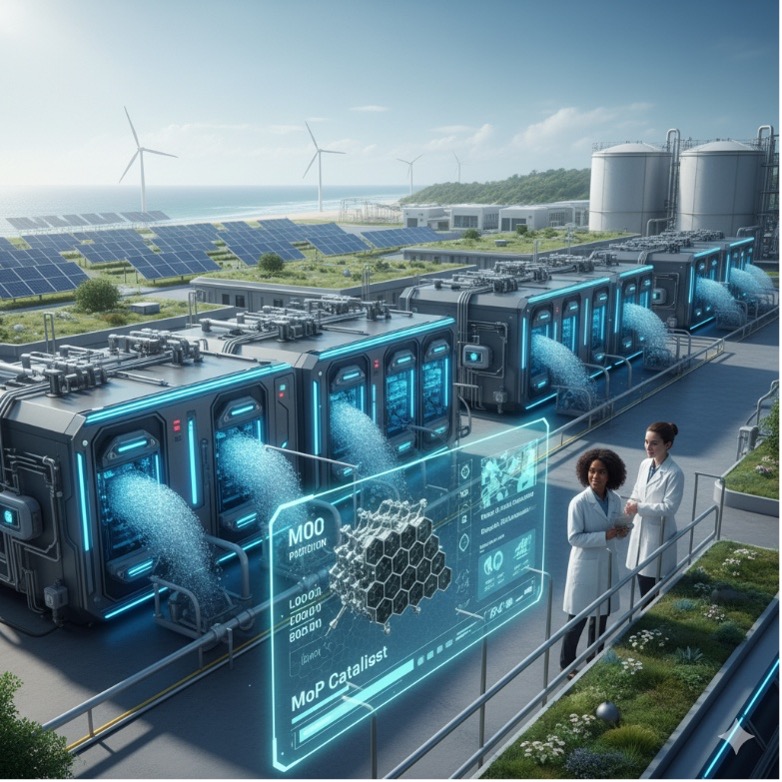
Challenge: Hydrogen is increasingly seen as the “fuel of the future” — carbon-free, clean, and applicable across industry, energy, and transportation. However, to make it truly accessible, it must be produced more cheaply and efficiently. Traditionally, expensive metals such as platinum have been used for this purpose, but they are not suitable for large-scale deployment. Scientists are therefore searching for new materials capable of catalyzing (accelerating) the reaction through which hydrogen is released from water.
Solution: A team of researchers from the Institute of Chemistry at Pavol Jozef Šafárik University in Košice and the Institute of Materials Research of the Slovak Academy of Sciences focused on molybdenum phosphide (MoP) — an inexpensive and readily available material with the potential to replace costly metals. They studied how MoP performs in different environments — from acidic to alkaline — and why it is able to maintain its efficiency.
The laboratory alone was not enough. The reactions on the catalyst’s surface are extremely fast and occur at the atomic level. To truly understand them, it was necessary to combine experimental research with computational simulations on a supercomputer.
Use of HPC Infrastructure
Collaboration with NSCC Slovakia and the use of a supercomputer enabled the researchers to create computer models of the catalyst and simulate what happens when hydrogen atoms bind to its surface.
Thanks to HPC, the team was able to:
- uncover the reaction mechanism — how hydrogen atoms behave on the surface of MoP
- verify the stability of the material in different environments
- predict potential improvements to the catalyst even before it is produced in the laboratory.
Impact
The outcome is significant for several reasons:
- MoP is cheaper and more accessible than platinum, which could reduce the cost of hydrogen production.
- The material works across a wide range of environments, meaning it could be deployed in various types of electrolyzers worldwide.
- The combination of experiments and HPC simulations saves both time and costs — allowing researchers to identify the best solutions much faster.
This research shows that HPC is not just for physicists or computer scientists — it can also play a crucial role in advancing green energy. Thanks to the computational power of the supercomputer, Slovak researchers contributed to global knowledge on eco-friendly hydrogen production and paved the way for new technologies that can directly impact energy independence and sustainability.
 Keď hmla nečakane udrie 22 Aug - Ako včas odhaliť hmlu ako „neviditeľnú“ hrozbu skôr, než ochromí naše cesty?
 Stop digitálnym pochlebovačom 16 Aug - Vedkyňa pomocou superpočítača prelomila zvyk modelov AI len prázdne chváliť a naučila ich dávať úprimnú, kritickú spätnú väzbu
 Odvrátená strana bezplatných hier 11 Jul - Ako slovenský tím s pomocou superpočítača vyriešil rébus extrémne vzácneho správania hráčov