
Summer of HPC: Neural networks in quantum chemistry
Join our team in Bratislava for the summer of 2021 and gain experience in programming neural networks and their usage in predicting molecular properties. PRACE partner countries and students studying at academic institutions in Europe have the opportunity to participate in summer internships at a HPC centre. Summer of HPC is a PRACE programme that offers summer placements at HPC centres across Europe to late-stage undergraduate and master’s students.
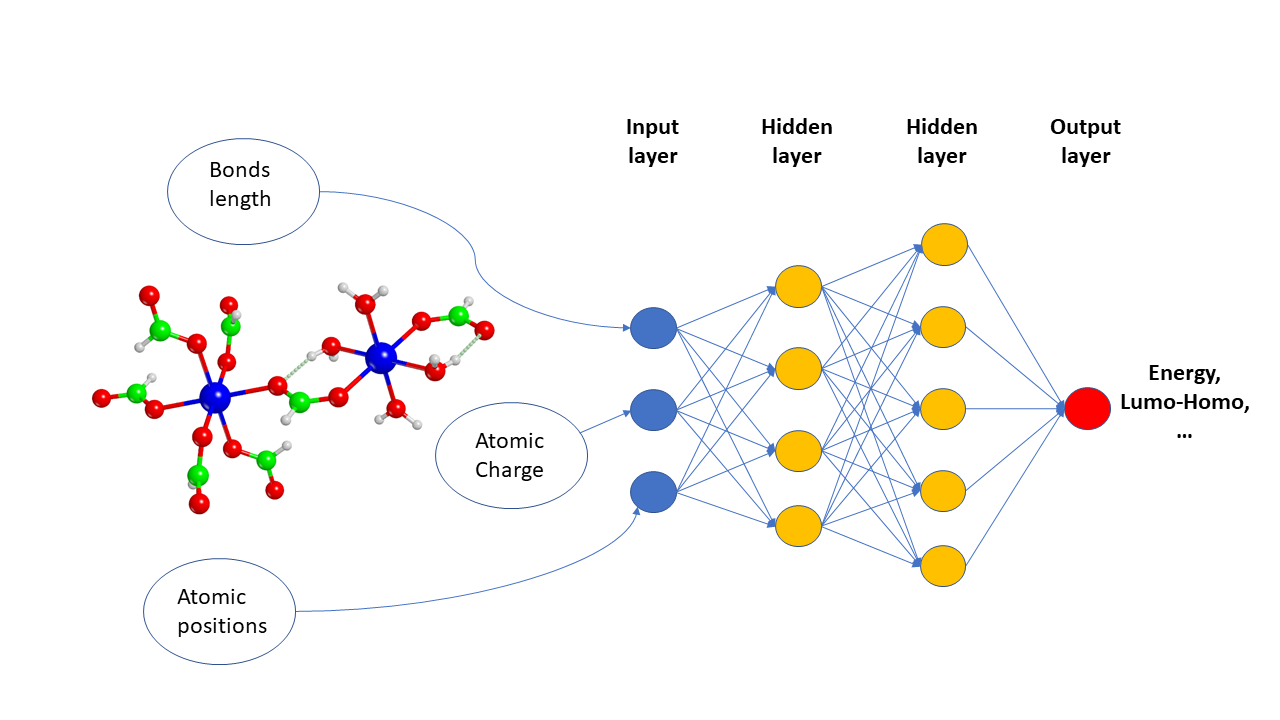
The main goal of this project is to investigate ability of NN frameworks to simulate molecular properties, where NN can emulate electronic wavefunction in local atomic orbitals representation as a function of molecular composition and atom positions or other molecular descriptors and representations. Our objective is to apply NN frameworks as predictor of molecular properties (energies, charges on atoms or evidence of hydrogen bonds) based on structural properties of these molecules (atomic positions). Implementation of NN frameworks will be performed using widely adopted TensorFlow library in Python code. For generation of molecular descriptors of chemical systems we apply DScribe library, which can be incorporated as a module directly in Python code. Next to the aforementioned “application part” of the project, we also plan to (in)validate the widely accepted fact, that GPGPUs are superior execution platform for NNs to CPUs.
Late-stage undergraduate and master’s students are invited to apply. Background in quantum-chemistry or physics is needed. We would alsowelcome advanced knowledge of fortran, basic knowledge of MPI, BLAS libraries and other HPC tools. Previous experience in HPC is not required as training will be provided. The most important attribute is a desire to learn, and share experiences with HPC.
Student will have access to the necessary learning material, as well as to our local IBM P775 supercomputer and x86 infiniband clusters.
The summer programme begins on July 1st and ends on August 30th 2021. At the end of the internship students present their projects and may win a prize for the best project!
Applications deadline is April 12th 2021.
 Keď hmla nečakane udrie 22 Aug - Ako včas odhaliť hmlu ako „neviditeľnú“ hrozbu skôr, než ochromí naše cesty?
 Stop digitálnym pochlebovačom 16 Aug - Vedkyňa pomocou superpočítača prelomila zvyk modelov AI len prázdne chváliť a naučila ich dávať úprimnú, kritickú spätnú väzbu
 Odvrátená strana bezplatných hier 11 Jul - Ako slovenský tím s pomocou superpočítača vyriešil rébus extrémne vzácneho správania hráčov