International Women's Day
History of IWD
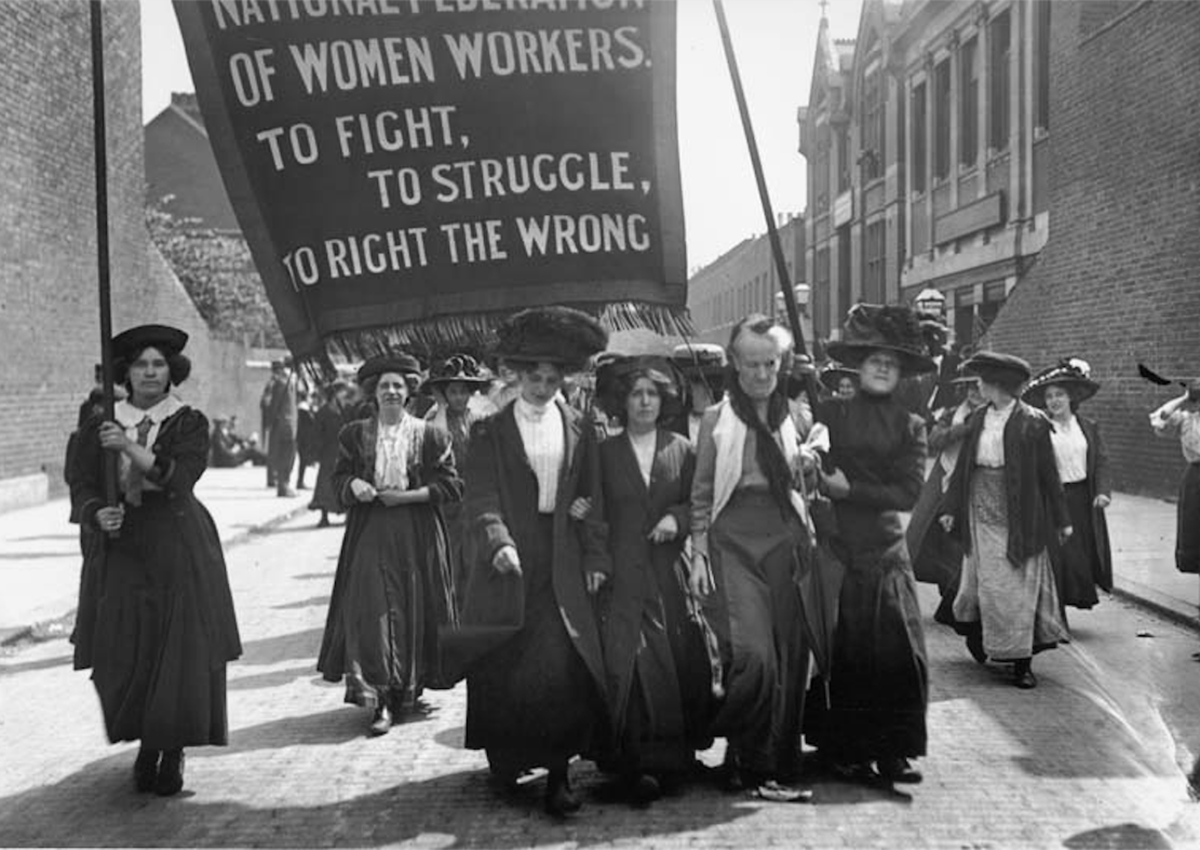
International Women's Day (IWD) is celebrated on March 8th around the world. It is a focal point in the movement for women's rights. The first National Women’s Day was observed in the United States of America on February 28th. The Socialist Party of America designated this day in honour of the 1908 garment workers’ strike in New York, where 40 000 women protested against working conditions. In December 1977, the United Nations General Assembly adopted a resolution proclaiming a United Nations Day for Women's Rights and International Peace to be observed on any day of the year by Member States, in accordance with their historical and national traditions.
International Women's Day is celebrated in many countries around the world. IWD is a day when women are recognized for their achievements without regard to divisions, whether national, ethnic, linguistic, cultural, economic or political. This day is a manifestation of solidarity between women and a reminder of the effort to equalize women and at the same time the longest revolution in our history.
In 1910, a second International Conference of Working Women second International Conference of Working Women was held in Copenhagen. A woman named Clara Zetkin (Leader of the 'Women's Office' for the Social Democratic Party in Germany) tabled the idea of an International Women's Day. She proposed that every year there should be a celebration on the same day in every country – an International Women's Day – to press for their demands. The suggestion received unanimous approval and thus International Women's Day was instituted.
The following year on March 19th, 1911, International Women's Day (IWD) was marked for the first time, by over a million people in Austria-Hungary, Denmark, Germany and Switzerland. In addition to the requirements for better working conditions, the right to vote, equal pay, etc. were also demanded. Since 1975, we have commemorated the IWD as a day of international solidarity of all women striving to achieve equality, justice, peace and development.
And what about IWD in Slovakia? The first IWD national holiday in Czechoslovakia took place in 1921 and a year later IWD acquired a mass character. During the Second World War IWD was abolished and subsequently renewed after 1945.
Women and IT
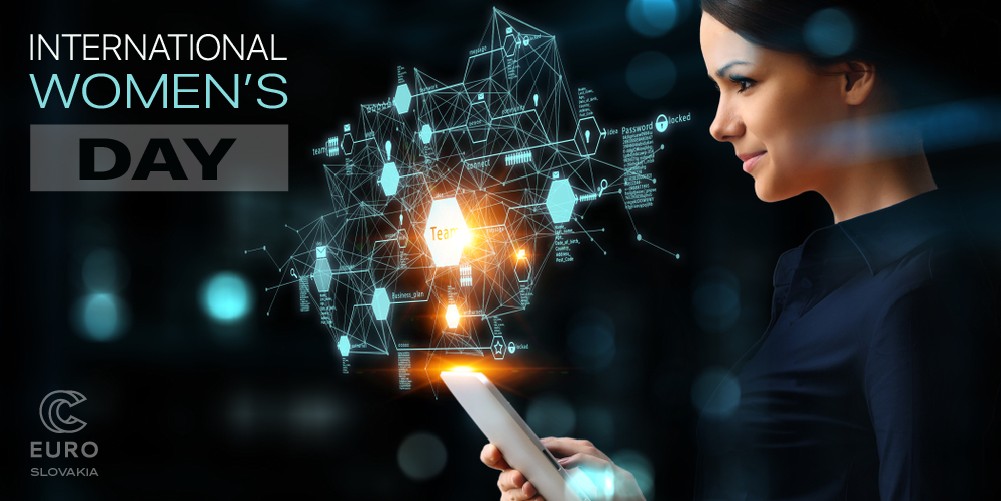
Women in the STEM fields (Science, Technology, Engineering and Mathematics), including information and communication technologies (ICT) are significantly under-represented.
„IT sektor trpí globálnym chronickým nedostatkom IKT špecialistov. Ženy sú podreprezentované na všetkých stupňoch digitálneho sektora v Európe. Hoci práve digitálny sektor sa rapídne rozrastá a tvorí stovky tisícov nových pracovných miest každý rok, pomer žien v tomto sektore klesá. Napriek dopytu po IKT zručnostiach a rastúcej nezamestnanosti sa predpokladá, že EÚ bude trpieť nedostatkom digitálnych zručností už od roku 2020. 52% populácie EÚ sú ženy, avšak reprezentujú len 17% zo všetkých IKT špecialistov a zarábajú o 19% menej v porovnaní s mužmi pracujúcich na rovnakých pozíciach. S 13.7% zastúpením žien v tejto oblasti je Slovensko pod priemerom EÚ.“ According to he Ministry of Investments, Regional development and Informatization of the Slovak republic the IT sector is suffering from a global chronic shortage of ICT specialists. Women are under-represented at all levels of the digital sector in Europe. Despite the fact that the digital sector is growing rapidly, creating incrementally thousands of new jobs each year, the proportion of women in this sector is declining. Although there is a demand for ICT skills as well as rising unemployment, the EU is expected to suffer from a digital skills shortage by 2020. 52% of the EU population are women, but they represent only 17% of all ICT specialists and earn 19% less than men for the same work. In Slovakia, women only represent 13.7% of all ICT specialist, placing our country below the EU average.
According to the study of the European Commission Women in the Digital Age the annual productivity loss for the European economy of women leaving their digital jobs to become inactive is calculated to be about 16.2 billion EUR.
The international project PRACE, in which Slovakia is represented by the Centre of Operations of the Slovak Academy of Sciences and which covers many of the HPC activities in Europe, brought attention to the examples of successful women working in this field in the Women in HPC publication. This publication is focuses on progress in the field of HPC and also on successful women in HPC sector. The number of women working in HPC is growing day by day, said Dr Sylvie Joussaume, the Chair of the PRACE Scientific Steering Committee.
In Slovakia, the AjTyvIT organization contributes to improving the balance of women in the IT fields by organizing educational events and courses for girls and women.
An IT community portal - robimeit.sk – publishes interviews with women in IT, bringing inspirational stories to the audience.
The National Competence Centre for HPC in Slovakia we follow the equal opportunity standards and adhere strictly to the anti-discrimination principles. We hope to join in the effort to increase the number of women studying or working in the IT field in our activities during the following year.
UN Women announces the theme for International Women’s Day, March8th, 2021 (IWD 2021) as, “Women in leadership: Achieving an equal future in a COVID-19 world.” On this occasion, the National Competence Center for HPC in Slovakia would like to extend the best wishes to all women and men to find the courage to challenge and lead our society to a positive change.
 Artificial Intelligence and a Supercomputer as a New Weapon Against Environmental Disasters 26 Mar - Scientists from Nitra, Slovakia are teaching machines to predict industrial failures before they can cause damage. Thanks to collaboration with the European supercomputer LUMI, they have developed a digital “guardian” capable of detecting pipeline leaks or manufacturing faults with high accuracy—helping protect both the environment and companies’ budgets.
 The Slovak Recipe for Fair Play and Happier Players 25 Mar - Do you play games on your phone and sometimes feel like the game just doesn’t understand you? Experts from Nitra, Slovakia, have used one of Europe’s most powerful supercomputers to change that. Thanks to the Italian giant named Leonardo, they discovered how to read between the lines of player behavior and make the gaming experience more personal and fair.


 Apply for the EUMaster4HPC Summer School 2026 focused on High-Performance Computing. 23 Mar - From 5 to 14 July 2026, the EUMaster4HPC Summer School titled “High-Performance Computing and Emerging Trends” will take place in Luxembourg. The event will be held at the Marienthal Youth Center and the University of Luxembourg in Belval.